


I’ve partnered with Orange, my phone network in France for the past seven years. I’ve found them to be one of the fastest and most reliable networks in the country.
After more than ten years in Paris and exploring all over France, I’ve always loved quirky restaurants with an unusual setting. Proper kitchens that happen to sit inside a cave, a 14th-century castle, or a metal marquee in a field in the Pas-de-Calais.
Here are five of the most unusual restaurants across France, in no particular order.
Le Train Bleu, Paris
Le Train Bleu sits up a staircase inside Gare de Lyon, and it’s the most beautiful dining room in the city that most people walk straight past on their way to a TGV. Built for the 1900 World’s Fair, it’s all gilt, frescoed ceilings and painted panels of the places the trains used to go. You can hear the departure announcements through the glass, which I love more than I should.
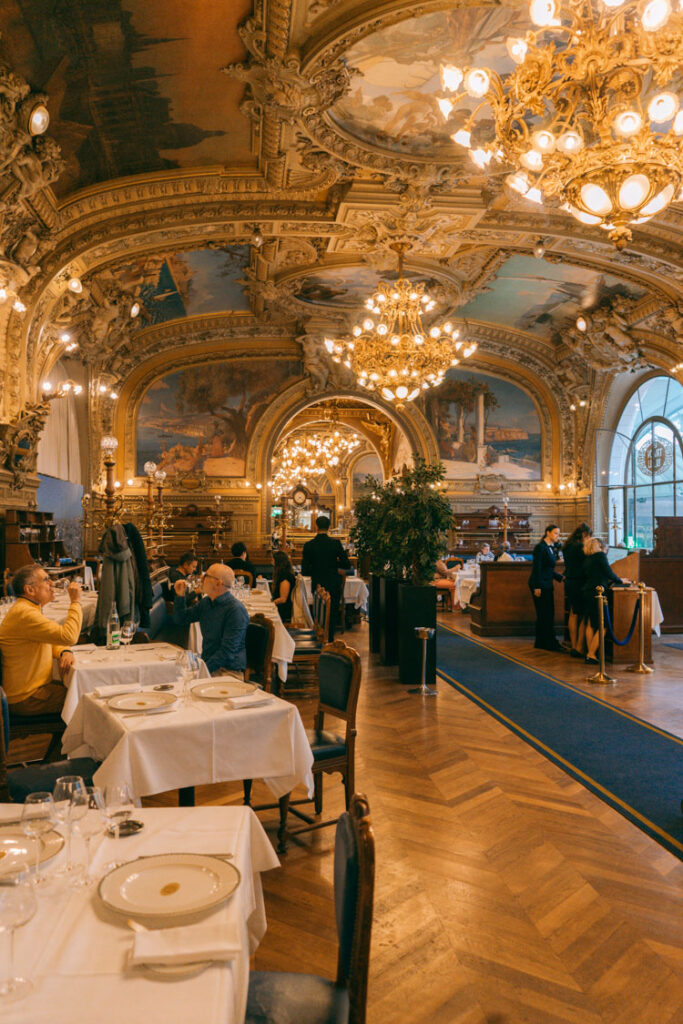
This is where I tend to take visitors. The cooking is classically French under Michel Rostang, with silver service of the sort that has quietly disappeared almost everywhere else. During my last visit we had the roast leg of lamb carved at the table and a lovely chou farci (stuffed and braised cabbage). It isn’t cheap. But you’re paying to eat lunch inside a listed monument.

Address: Gare de Lyon, 75012
Tel: 01 43 43 09 06
Les Caves de la Genevraie, Louresse-Rochemenier
South of Angers, in Anjou’s troglodyte country, you eat underground. These caves were cut out of the soft tuffeau rock and used as hiding places during the wars of religion. Now they hold long communal tables and a wood-fired oven.
There’s one menu and no choosing. Fouées, small hollow breads baked in the wood fire, arrive hot in batches and you fill them yourself: rillettes, white beans, goat’s cheese. Apéritif, wine and coffee are all included in the price.
Address: 13 rue du Musée, 49700 Louresse-Rochemenier
Tel: 02 41 59 34 22
Open Friday evening to Sunday lunch for most of the year, daily except Monday in July and August.
La Grenouillère, La Madelaine-sous-Montreuil
Alexandre Gauthier’s two-star restaurant sits in a field an hour or so down from Calais, which makes it the most achievable serious meal here if you’re driving through. The old farm buildings still stand, but architect Patrick Bouchain dropped two low metal marquees onto the site, so you eat in something between an aircraft hangar and a greenhouse, opening straight onto the garden.
Gauthier’s cooking is famously radical and rooted in the marshland around it. There are huts in the garden to sleep in, which is the version to book.
Address: 19 rue de la Grenouillère, 62170 La Madelaine-sous-Montreuil
Tel: 03 21 06 07 22
Château de la Treyne, Lacave
A 14th-century castle on a cliff above the Dordogne, with towers sitting so close to the water they look like they’re floating on it. Lunch is on the terrace over the river. Dinner is in the Louis XIII salon, by candlelight.
Chef Stéphane Andrieux holds a Michelin star here and cooks the south-west without apology: veal from calves suckled by their mothers, truffle, foie gras, asparagus in spring. It’s a hotel as well, and you should stay. Driving those lanes after a wine pairing is nobody’s idea of a good evening.
Address: Lacave, 46200
Tel: 05 65 27 60 60
Créatures, Paris
Back to Paris for the last one. Créatures is on the roof of Galeries Lafayette Haussmann, with the Opéra Garnier and a sea of zinc rooftops in front of you. There are vegetable beds around and above the dining room, and a good deal of what lands on the plate is cut from them.
Julien Sebbag’s menu is entirely vegetarian and mostly Mediterranean: charred vegetables, herbs, olive oil. It’s seasonal, spring and summer only, so check before you plan around it.
Address: 40 boulevard Haussmann, 75009
Before you book
All of these need booking well ahead. The starred kitchens release tables weeks out and fill them in hours, and the cave is only open a few days a week for most of the year.
Almost every restaurant in France will ask for a contact number, and they’ll nearly always ring the day before to confirm. Miss that call and you can lose the table. So it really does matter to be on a network that works, particularly out in the countryside (trust me on this one). I’d recommend Orange in France: Arcep’s 2025 survey put them top for the fifteenth year running, and the gap is widest in rural areas, where they managed 83% perfect-quality calls against 77% for Bouygues and 76% for Free.
If you’re visiting from outside Europe, Orange Travel sells a prepaid eSIM for European trips, starting at €24.99 for 20GB over a fortnight. You activate it before you fly and land with maps and your booking confirmations already working, rather than queuing for a SIM at the airport.
Then just turn up hungry.